

Key Takeaways
- UEFA president Aleksander Ceferin and CONCACAF president Victor Montagliani sent a joint letter demanding FIFA distribute at least $10m from its estimated $6bn reserves to each of its 211 member associations.
- The confederations argue that “development is an institutional responsibility of FIFA – not a matter of individual discretion” following the collapse of the commercial FIFA Forward Enterprise plan.
- UEFA vice-president Laura McAllister urged modernisers worldwide to unite before the November 18 deadline, stating “there has to be a challenger to Infantino” in the upcoming presidential election.
UEFA and CONCACAF urge FIFA to distribute excess reserves
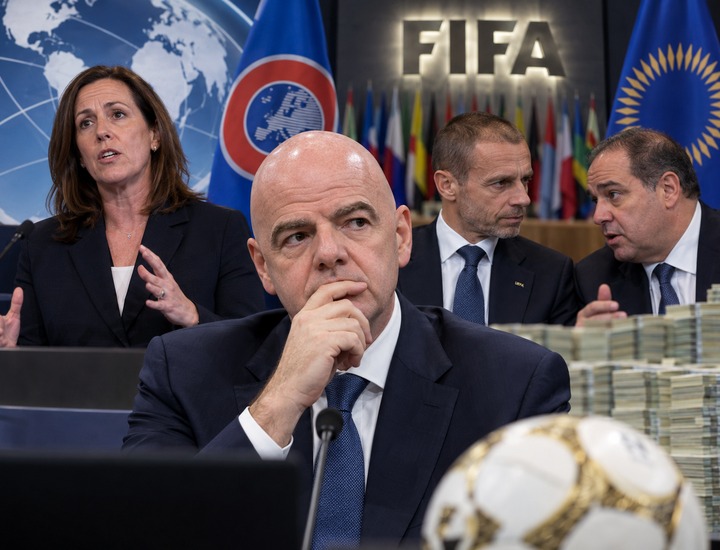
UEFA and CONCACAF have sent a joint letter to FIFA president Gianni Infantino demanding that at least $10m from the governing body’s reserves be distributed to each of the 211 member associations. The request follows the collapse of the FIFA Forward Enterprise project, which sought to part-privatise world football’s governing body.
Signed jointly by UEFA president Aleksander Ceferin and CONCACAF president Victor Montagliani, the correspondence points out that football’s global authority is sitting on an unprecedented cash surplus. According to the document, “FIFA is on course to close 2023-26 with reserves of approximately $6billion,” which both confederation leaders described as “[This is] considerably more than is required.”
The two confederations want Infantino to “make at least $10m available to each of [FIFA’s] 211 member associations over the 2027-30 cycle”. Fulfilling the demand would require a payout of $2.11bn, which would be delivered on top of existing, pre-planned development funding.
Dispute over commercial plans and reserve funds
The push highlights growing frustration among senior confederation figures who believe FIFA ought to finance projects from its own deep accounts rather than turning to private capital. Infantino had sought to secure $4.2bn from outside investors, including Joshua Kushner, an amount that closely mirrored the reserves held by FIFA after the 2022 World Cup.
Prior to shelving the venture, Infantino had offered national federations two separate joining payments of $20m each in exchange for backing the commercial model. However, federations including the English Football Association argue that FIFA, operating as a not-for-profit body with expanding revenues, should draw down its accumulated funds instead.
In their joint communication, Ceferin and Montagliani emphasised that surplus wealth should benefit the sport directly, writing that “FIFA currently holds billions of dollars in accumulated reserves. These resources belong to football and exist to serve the game and its 211 Member Associations.”
The letter added: “Prudence should not prevent a careful examination of whether a portion could responsibly be released to the extent those reserves exceed FIFA’s foreseeable needs. Releasing part of these reserves would demonstrate that member associations should not have to choose between development and good governance; between investment and integrity; or between financial support and the ability to consider proposals on their merits.”
The leaders concluded: “Development is an institutional responsibility of FIFA – not a matter of individual discretion.”
Growing pressure and election uncertainty
Ahead of the FIFA Council meeting scheduled for October 15 in Zurich, UEFA and CONCACAF have been actively seeking support from other confederations. At the same time, English FA chair Debbie Hewitt has urged Infantino and FIFA secretary general Mattias Grafström to publish all documentation concerning the enterprise plans, as well as the justification for overturning US forward Flo Balogun’s red card from the match against Bosnia during the World Cup, an intervention that occurred after lobbying from US President Donald Trump.
Speaking at the World Football Summit in Madrid, UEFA vice-president Laura McAllister outlined the deepening discontent surrounding Infantino’s administration. “In the weeks since the exposure of FFE, we have seen a gradual seeping lack of confidence in the leadership of Gianni Infantino,” McAllister stated. “It wasn’t just about that initiative, there have been a series of episodes or incidents over recent months and years that have undermined the confidence in his leadership.”
Highlighting recent controversies, McAllister noted: “Most recently, there was the overturning of the red card of Balogun at the World Cup, and the FIFA Peace Prize over which there was no consultation… despite it being hugely political.”
With an election looming next March and a nomination deadline of November 18, McAllister insisted an alternative candidate must step forward. “There has to be a challenger to Infantino because he will certainly, as he already said, be a candidate in the election unless something dramatic happens in the coming weeks,” she said. “Of course, it could do, but legal processes take a long time, so let’s not hold our breath over that.”
Outlining the profile of who should emerge, McAllister stressed: “There has to be a candidate who, first of all, can command the support of all modernisers beyond just Europe. Football doesn’t belong to Europe. Yes, we are a very powerful confederation and, yes, we generate a lot of funds, but football belongs to every single federation and club across the world.”
She continued: “We have to unite people around a candidate, or maybe more than one candidate, and that candidate, whoever he or she is, has to stand on a manifesto of agreed reform: of greater transparency or greater accountability, of less political interference and must recognise the role of the FIFA President should be to run football, and not to involve himself in other ventures, whether that’s via the private or political sectors.”
McAllister concluded: “I hope very much there will be a candidate and I think that’s where we are at the moment. Lots of work is happening behind the scenes. But we need a candidate with an ethos of credibility and modernisation, showing why they should win the election next March.”
Montagliani is viewed as a potential challenger, though Infantino still commands the declared backing of more than 106 associations despite several European federations rescinding their earlier endorsements.